
Film Preservation Studies

The postgraduate in Film Preservation Studies forces students to confront the (theoretical, technical and ethical) dilemmas generated by film as part of our tangible and intangible heritage
In addition to addressing all aspects linked to the identification of images and sounds in photochemical, magnetic and digital format, the course also deals with the tools required for managing existing collections and creating new ones.
It introduces students to audiovisual material review, preservation and restoration protocols and procedures, through both mechanical and digital tools, enabling them to gain real practical experience in the lab.
The labyrinth of images of our time
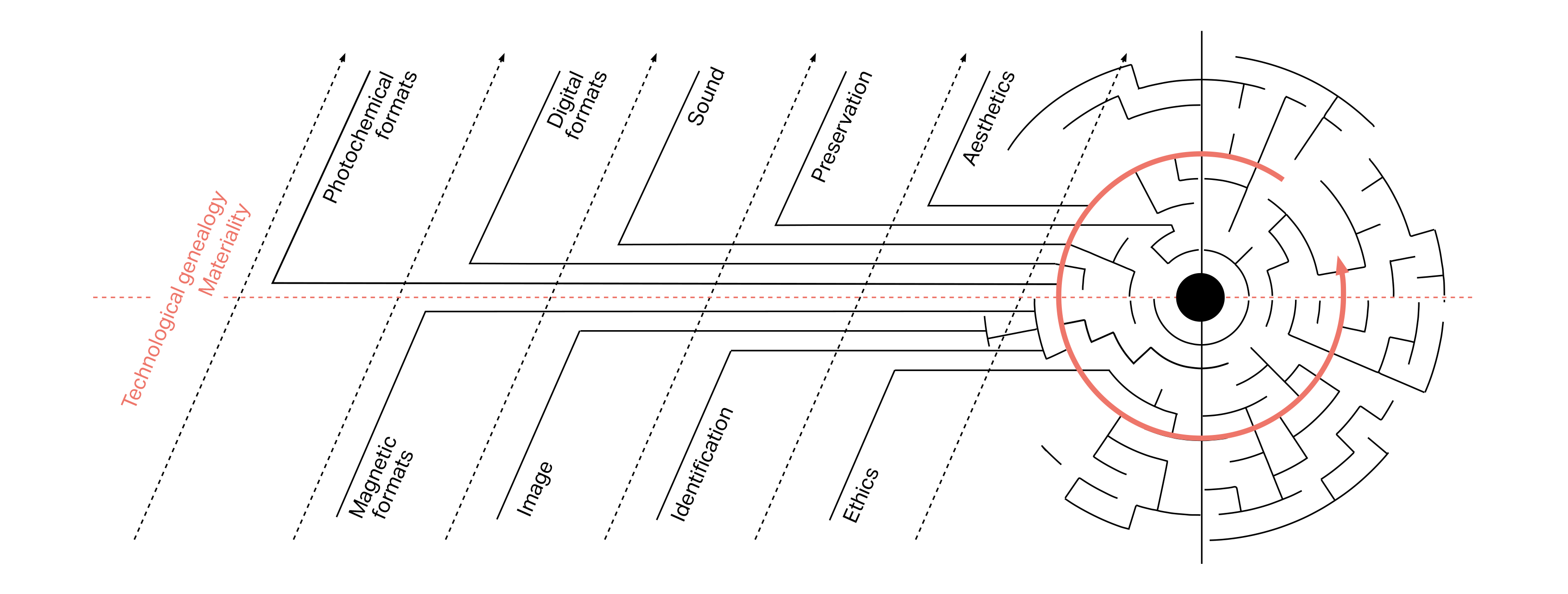
The structure of the Film Preservation Studies master’s degree course approaches cinema through its material nature and technological genealogy. The first two modules explore the photochemical origin of film images, and the subsequent ones focus on the peculiarities of the magnetic and digital formats. These branches together form a common set of specific knowledge: each image and each sound poses unique questions about its identification, degradation, preservation and cataloguing, but also about aesthetic and ethical issues, about the future of cinema, its sense of history and the profession of the archivist.
The content systematisation and working methods proposed by the course do not, however, lead to a simple and/or simplified understanding of the material under study. Quite the opposite, in fact; at the end of their journey, students are invited to explore the ‘grand memory of images’ from a complex and paradoxical perspective. And this is just as it should be, because even when the path to follow is perfectly defined, the journey of an archivist always leads eventually to the labyrinth of images of our era. The greatest treasure we could ever inherit.
The Film Preservation Studies course is in constant dialogue with the work carried out by the Basque Film Archives, which enables students to experience first-hand what it is like to work in an FIAF-approved film archive.
The coordinator of the Film Preservation Studies course is Clara Sánchez-Dehesa Galán, a specialist in the preservation and restoration of audiovisual material and a graduate of the L. Jeffrey Selznick School of Film Preservation, New York.
The art of aberration. Histories and aesthetics of cinema
Joxean Fernández
Carlos Muguiro
Module: 1, 5
This is a course on the aesthetics and history of cinema, approached from the crossroads of the present; a moment in which, beyond the crisis being experienced by the very concept of history as a totalising narrative, real suspicion is spreading about the ordering of diachronic time and the idea of progress. Specifically, the subject questions whether it is even possible to chart the history of cinema from our own time. And it does so in the hope that it is, or in other words, with the aim of telling the (hi)stories (plural) that together make up the history of cinema. In a more general sense, it is also a subject about time, pure and simple. Throughout the first two decades of the 21st century, the categories that have traditionally be used to structure a hundred years of cinema, all of which are based on stylistic dichotomies (classicism vs. modernity) or teleological parameters, have been called into question by the different movements of revisionist historiography that often transcend the cinematographic. Cultural studies, affective theories, media archaeology, the analysis of reception, cultural materialism, ecocriticism and gender and postcolonial studies are just some of these critical approaches. Historians have added the word ‘turn’ to their vocabulary (the affective turn, the archival turn, the materialist turn), graphically demonstrating the need to rethink the linear and evolutionist approach that has traditionally been adopted in relation to cinema.
However, from localised places of resistance, collectives and minorities focused on microhistory and subaltern histories, alternative narratives from below, critical stances that oppose academic hegemony and university sufficiency have arisen. How, then, can we approach the narrative of film history without automatically rejecting our heritage or falling into the trap of denialist cynicism, an exogenous and scientistic perspective, or a simple lack of curiosity? To what extent should the narrative of film history in a film school also be the narrative of our own memory? Are we part of that history we reject? In this sense, this subject on time in cinema is also a subject on our time in cinema.
With the aim of addressing the possibility of history not only theoretically but also from an applied perspective, the subject proposes a dialogue-based methodology featuring divergent yet complementary voices throughout the different sessions. The idea is to construct a paradoxical and plural history that is open, rhizomatic, nonlinear, carnivalesque and metamorphic. In this sense, we will follow the path laid down by Nicole Brenez when she warned that ‘cinema never ceases to tear itself apart, to deepen its fractures, to vary the powers of the discontinuous and its double, to work on the caesura and to allow defection to work.’
Practices and Policies in Film Preservation
Carolina Cappa
María Fuentes
Ricardo Matos Cabo
Module: 1, 3
The course aims to study film preservation from a transdisciplinary perspective and to establish a shared conceptual framework for the entire Film preservation programme. Taking a theoretical and practical approach, the course will seek to consider preservation as a critical, situated and evolving practice, involving aspects of technology, history, research and institutional policies. Film heritage will be discussed through the history of preservation, the study of international standards and new possibilities for creating alternative working models that give a voice to previously neglected histories and territories. Through theoretical classes, case studies and sessions with guest speakers, we will examine film restoration, digitisation, collection building and the theory of the film archive as a set of practices shaped by historical, institutional and cultural forces that determine what and how we preserve today.
The machines of the cinema: Evolution and Adaptation to the Archive
Clara Sánchez-Dehesa
Module: 1
This module offers a historical overview of the evolution of cinema, aimed at understanding how each technical development enabled specific forms of cinematic expression and aesthetics, whilst also identifying which tools derived from these technologies are still operational today for accessing photochemical content within an archival context. The theoretical section will cover the technical evolution of both photochemical media and the technical equipment used in each era of audiovisual production. In the practical part, students will learn to use some of this equipment, recovered from old laboratories, which enables photo-chemical materials to be handled safely within an archival setting for the purposes of study and conservation.
Archives and Research Methodologies
Module: 1
This subject offers EQZE students on the Film Curating and Film Preservation itineraries the opportunity of taking on an exploratory role (researcher and curator) within film and audiovisual archive practice, bearing in mind the three (always intertwined) tenses of cinema: the past, linked to memory; the present, linked to action; and the future, linked to screening. This subject aims to equip students with the theoretical, methodological and practical tools necessary to undertake academic and curatorial research based on archival collections. This subject is common to both the Film Preservation and the Film Curating itineraries.
The photochemical image I. Developing in black and white
Niko Iturralde
Module: 1
This subject invites you to explore manual black and white, negative and reversible development procedures in the laboratory. Using material filmed at the school, you will learn about the specificities of each development process. You will also come to understand how the chemical substances used interact with both the structure of the film and other key aspects for ensuring adequate conservation. This subject is common to both the Film Preservation and the Filmmaking itineraries.
The photochemical image II. Vostok film developer
Niko Iturralde
Module: 1
The aim of this subject is to teach you to develop black and white, negative and reversible film mechanically on a film developing train. This enables you to understand and appreciate every step of the process, from the moment the image is captured to its materialisation in the form of a visible negative. Learning to master chemical substances, times and temperatures will not only help you develop precise technical skills, it will also provide a unique emotional and artistic experience. This subject is common to both the Film Preservation and the Filmmaking itineraries.
The cataloguing, documentation and curating of archives
Santiago Aguilar
Module: 2
This subject adopts a theoretical-practical approach to the cataloguing of audiovisual works and associated documentary processes. Where can we find reliable information? How should we manage the issue of copyright? Why is the unitary concept of a work losing ground to perspectives based on versions and manifestations? Since the beginning of film at the close of the 19th century, right up until the emergence of video at the beginning of the nineteen-seventies, all audiovisual works were shot in photochemical format and it was in this same format that they were both distributed and conserved. Technological changes have always destroyed some materials and rendered other inaccessible due to the obsolete nature of the devices required to reproduce them. From this perspective, the definition of new standards poses certain challenges for preservation, while at the same time facilitating documentation and cataloguing processes. The identification and classification of works and their various versions in standard and substandard formats constitute a key practical part of this subject. This subject is common to both the Film Preservation and the Film Curating itineraries.
Identifying and preserving film materials
Oskar González Mendia
Clara Sánchez-Dehesa
Lorena Soria
Module: 4
This subject explores film documents preserved in archives, with special attention being paid to their technical characteristics and the critical analysis of materials. It also analyses the relationship between the element and the work and examines photochemical formats, their deterioration, the chemical reactions associated with degradation processes and the influence of environmental factors. Students will learn methodologies for inspecting, cleaning and treating different elements and inventorying and evaluating collections, as well as research methods aimed at the preservation and restoration of film works.
Identification, preservation and digitization of video materials
Gema Grueso
Module: 2, 4
Research into the history of video formats, their uses and technical characteristics, risk factors and deterioration, and the principles and tasks of collection management. The course will cover both analogue and digital materials stored primarily on magnetic tape, although it will also examine the principles of storage, risk factors and deterioration in other digital video storage systems such as optical discs and removable storage systems.
Video collection management will include risk assessment, preventive conservation, prioritisation of formats, and various medium- and long-term conservation solutions. Decision-making will be supported by objective data and aided by various metadata standards and storage conditions to describe and protect the different media. The characteristics of analogue and digital video signals will be reviewed to identify the requirements for the files resulting from digitisation, including the possibilities and standards currently in use. These requirements, together with knowledge of the functions of the various devices that may make up a digitisation system, will enable students to evaluate and adjust the various settings to ensure correct digitisation and transcoding.
Finally, the course will cover the basics of compliance and quality control for the resulting files, common errors in digitised formats and their possible causes/solutions, and the principles and requirements for the long-term preservation of digital files.
Identification and preservation of digital files
Peter Bubestinger
Module: 3
Preserving “digital assets“ is by now nothing new. Yet, due to the fast and everchanging pace at which digital systems, and their underlying electronics are being changed, it has become more and more useful and necessary to getting to know not only the “nature“ of digital data itself, but also being aware of which components, trades and aspects influence their lifecycle.In this class, the students will get to know and understand “what is a file“. Which parts, processes and systems should work together to not only preserve digital data intact, but also make it find-able and (re-)usable under yet unknown, future conditions.This includes introduction to commandline interfaces, simple programming/automation basics and media-format conversion - which have proven invaluable for sustainable professional work with digital data. This foundation of understanding digital data/documents is then gradually connected to best practice for deciding, defining and maintaining the infrastructure and workflows for building a proper digital preservation strategy. The students will learn theories and modern practices, and how these technical properties, access- and conservation-policies/strategies influence each other.
Digital processing of images I: Digitisation
José Luis Sanz
Module: 3
The digitisation of photochemical material is a widespread practice today in all international archives and film libraries. In all modern archives, the conservation and dissemination of materials, as well as research activities, necessarily involve digitisation processes. Students will learn the basics of digitisation, along with the strategies they need to follow in each specific case. They will also have the opportunity to put their knowledge into practice throughout their training at school.
Digital processing of images II: Diamant
Luis Alberto Juárez
Module: 4
This workshop will give students the chance to familiarise themselves with the workflows involved in the digital restoration of film images by learning how to use the DIAMANT-Film Restoration Suite / HS-ART software, its suite of tools, possibilities, limitations and risks, whilst gaining an understanding of the basic features of a digital restoration process, its ethical implications and its potential scope through practical work on specific materials.
Digital processing of images III: Da Vinci
Clara Rus
Module: 4
The aim of this course is to help students understand and become familiar with film restoration tools using the DaVinci Resolve software package. It also aims to teach them, using real examples, how to apply techniques for facilitating the restoration of cinematographic materials, as well as how to resolve any technical doubts that may arise. During the workshop, students will develop the color of the proposed exercises in order to be able to work autonomously. They will see all the phases of the colorization of a project: forming, primary, secondary, mastering, etc. A personalized follow-up of the work of each student will be carried out during the class, resolving doubts and conflicts until their understanding. The purpose is that each student knows how to face the restoration material in order to recover it as much as possible.
Management of audio-visual collections
Silvia Casagrande
Module: 5
This subject provides a comprehensive overview of the management of audiovisual archives in the contemporary ecosystem. The programme will analyse the main aspects of the preservation and stewardship of audiovisual heritage, linking them to the specific nature of each institution and its collection policy.
It will also address the issue of material accessibility, exploring the various access options and the limitations that affect a collection’s visibility.
The course will also analyse the archive’s relationship with its physical and social environment, examining the environmental impact of the contemporary archive and digital preservation, and evaluating possible alternatives to reduce its carbon footprint. Furthermore it will analyse the archive’s capacity to manage climate emergencies and its role in addressing the challenges of today’s society.
The ultimate aim is to equip students with the necessary tools to adapt to different realities and to be able to plan and implement strategic collection management plans. This subject is common to both the Film Preservation and the Film Curating itineraries.
Sound history and restoration
Franco Bosco
Module: 5
This subject includes an initial theoretical part in which we will address the basic concepts of film identification, paying particular attention to sound materials. We will analyse the main characteristics of the most common sound formats in film production, as well as the primary physical characteristics of sound and the most relevant concepts linked to its digitisation and restoration. In the second (principal) part, we will work directly with film materials.
The art of Primitive Emulsions
Esther Urlus
Module: 4
This workshop looks at the production of home-made photochemical emulsions. Although it is based on film archaeology, it explores many contemporary creative questions. It is a workshop for those interested in the history of materiality, although it will also appeal to filmmakers curious about film not just as a means of storing their ideas, images and soundtracks, but rather as a material that actively forms and distorts these ideas, images and sounds.
Zinebotanika
Cris Neira
Module: 4
Making a botanical film is above all a work of patience and affection. Taking as a starting point the methods of film without a camera and some tricks of the amateur gardener, we will create a collective filmic herbarium, from the collection of specimens to their projection.
This workshop is aimed at people from all backgrounds who want to explore alternative methods of filmmaking. Cinebotanicals are, after all, accessible proposals that allow the reuse of filmic support materials and tools to give rise to a piece whose control always remains in the hands of nature itself.
Starting point
Michel Gaztambide
Module: 1, 3
This courseseeks to confront students with the nature of their film and the methodology of approach. Where does your film come from? What is it about? What emotion is it trying to arouse? Can it be told in images? How does the author want the spectator to feel at the end of the screening? From these and other issues, the course is intended to initiate – or get back to, in some cases – the processes of reflection and development of the work process that will culminate in the film. The course basically focuses on three points: first, working with the Starting Point or origin of the film as the soul of the creative journey; second, the need to expand the scope of this journey from concrete elements capable of adding complexity and depth to the film and, finally, the concreteness of the project from the writing stage.
Observatory of sound
Xabier Erkizia
Module: 3
The Observatory provides a space for training, practice and research in sound. It starts from the zero degree of listening to deny the existence of silent cinema, explore the impact of technology, the sound design of gestures and everyday objects, radio art, sound ethnography, sound art... In addition to pre-established themes, it can also adapt to the specific needs of group members at any time, linking into practical work and projects under development.
Video-essays and rewritings of history
Cristina Álvarez López
Adrian Martin
Module: 3, 5
Film history and film criticism are disciplines that are constantly engaged in a creative and critical process of rewriting. Filmmakers and critics do not create from scratch—their work is always, consciously or unconsciously, a response to previous artistic manifestations. In recent years, audiovisual essays have become a prominent example of this critical rewriting. In this subject we will establish relationships between different audiovisual essay formats and different periods, trends and ideas in film history and criticism. The subject also includes a practical exercise.
Igniting the word: poetic writing workshop
Mar González
Module: 3, 5
Words are worn out, sunk under the weight of unconscious use. They come and go in a lazy drift, victims of inattentive use and learned inertia. This subject invites you to set fire to that dull tumult of dry words. It aims to rescue them from indifference, open them up, one by one, and place them in a text. But to do this, we must first cultivate a certain degree of linguistic craftsmanship. It is not about waiting for inspiration to strike, but rather about writing a lot and reading even more. Genius, the muse, pneuma, or the duende, as Lorca would say that ‘mysterious power that everyone feels and no philosopher can explain’, cannot be taught and has no instructions manual. Yet, as Baudelaire observed it ‘obeys, like hunger, like digestion, like sleep’. Therefore, the only way to reach it is through work, process, practice: immersing oneself in the technique, so that when it arrives, it finds fertile soil.
Igniting the word is therefore about observing with open senses, searching for the precise word, the exact phrase, the necessary image. It is, in essence, a writing workshop that uses the ignited word to summon emotion.
OUCIPO or Potential Cinema Workshop
Oskar Alegria
Module: 3
Five sessions that explore cinema as a game full of chance, poetry and mystery, featuring screenings of ‘nameless’ films and field trips just an hour’s bus ride away—combining a visit to a sand cemetery with the oldest stone age map, or shutting oneself away in a temple designed to harbour the night within. Inside, it is always night. Experiencing cinema in a personal and bespoke way, bearing its rules in mind—above all, to break them. Just as George Perec and his allies did with limitations, turning them into freedoms, guided above all by the gaze of that dark cat called Duchat who would always perch on his shoulders to meow in his portraits.
EQZELab. Professional film laboratory
Yolanda Cáceres
Module: 5
The last stage in the gradual acquisition of knowledge, skills and abilities linked to the processing of photochemical films. The subject introduces students to the techniques and workflows of a professional laboratory through the practical handling of specific technologies for developing (16 mm colour and black and white), colour correction and copying. By acquiring these practical skills, students also help maintain inter-generational knowledge of the film culture and industry that would otherwise be lost. Furthermore, those on the course can assume responsibility for processing the film materials generated at the school, thereby keeping the EQZELab service active.
Uses of Artificial Intelligence in Contemporary Cinema
Jorge Caballero
Anna Giralt Gris
Module: 4
The advent of AI in contemporary cinema goes well beyond the generation of images; it serves as a tool for reading, classifying and reorganising archives, and as a means of synthesis capable of producing plausible images, sounds and textures without leaving any trace of an index. The workshop offers applied and critical training focused on documentary and non-fiction cinema, with specific attention to archives, evidence, transparency and how to uphold values when whatever has been recorded, altered or fabricated become indistinguishable. It combines technical literacy, a methodological framework for maintaining credibility and practical exercises using current tools.
Interpreting and preserving complex media artworks
Mona Jiménez
Module: 3
Using a case study format, this course engages students with complicated contemporary artworks in order to understand the primary issues and emerging strategies for the conservation of media art. Artists use a wide variety of audiovisual formats and technologies to create complex installations that are fascinating to study. Examples range from artworks using obsolete components like TVs (cathode ray tubes) to multi-channel synchronized works, works using game engines or custom code, or works that pull data from the Internet. These artworks typically contain many interrelated parts that must be deciphered and documented to ensure the artwork will function in the future in a manner that is faithful to the artist's vision.
The course combines curatorial and conservation perspectives in the study of several artworks held in the collection of a local contemporary art museum. Students research exhibition histories, consult institutional files, examine an artwork's component parts, and discuss the artworks with museum staff. In the process, a great deal will be learned about the interpretation, care, and conservation of artworks in museums and archives.
Students of the 2025-2026 Academic Year
